
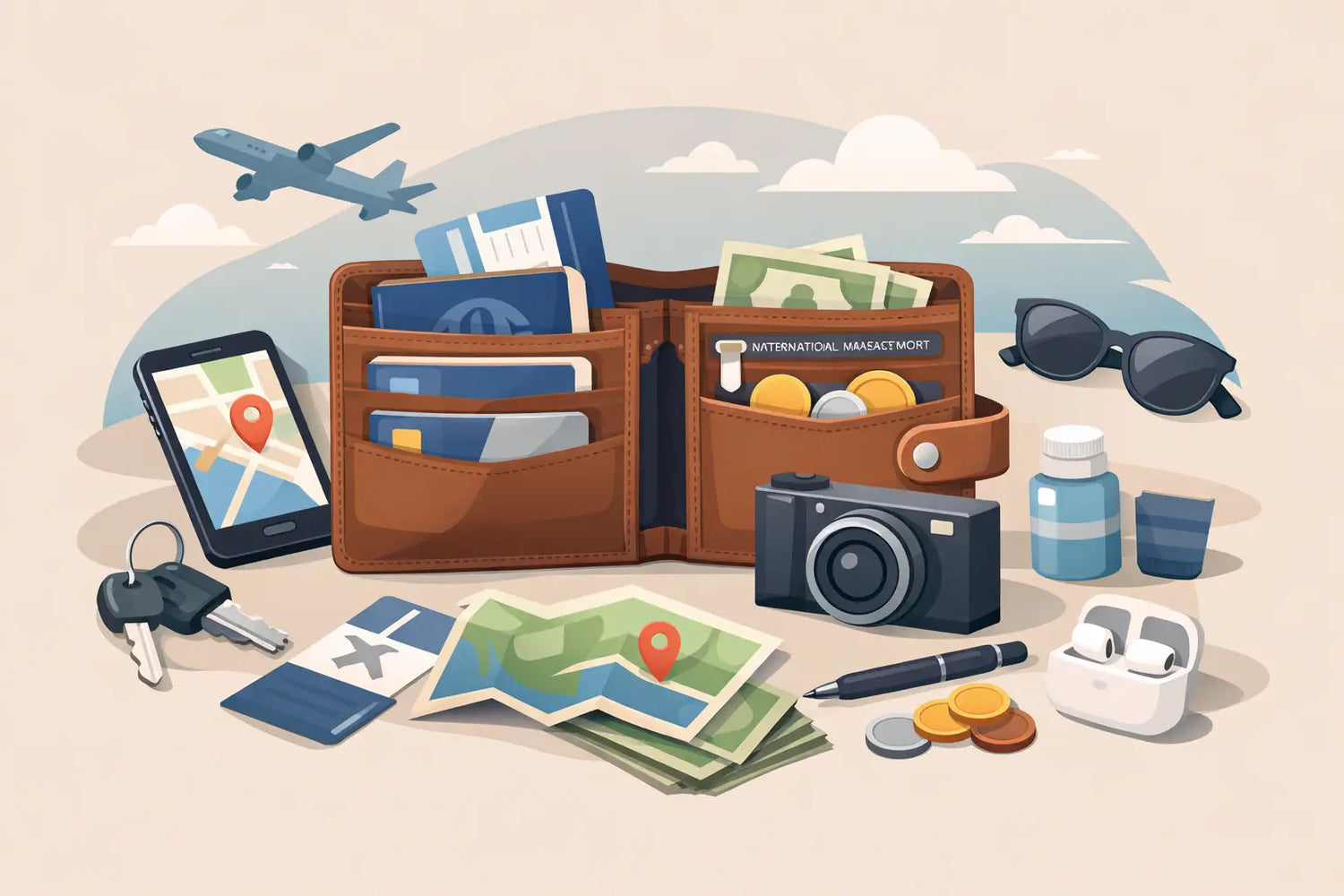
A bloated passport holder looks organized until you're at security, one hand on your bag, the other flipping through receipts, loose cash, and three cards you do not need. The real answer to what to carry in a travel wallet is simpler: only the items that earn their place in transit.
A good travel wallet should reduce friction, not create it. That means quick access at check-in, a clean setup at immigration, and zero pocket bulk once you land. If it feels overpacked before takeoff, it will feel worse halfway through the trip.
What to carry in a travel wallet for smooth travel
Start with the items you are most likely to reach for while moving through an airport or train station. For most travelers, that means your passport, primary payment cards, some cash, and your boarding pass if you use a paper copy. These are the true essentials. Everything else depends on how you travel.
Your passport is the anchor item. If you are crossing borders, it needs a dedicated place that keeps it flat, protected, and easy to pull out without fumbling. Folding it into a back pocket or burying it in a tote slows you down and increases the chance of damage.
Next come payment cards. Carry the cards you actually plan to use, not your full collection. One primary credit card, one backup card, and perhaps one debit card for ATM access is usually enough. More than that adds thickness fast. A travel wallet works best when every slot has a purpose.
Cash still matters, even on trips that are mostly digital. Keep a small amount in the local currency if possible, plus a little backup in your home currency for arrival or emergencies. The key is restraint. A thick stack of bills turns a slim wallet into a lump in your pocket.
If you prefer paper boarding passes, keep the current one only. Old stubs, luggage tags, and printed confirmations build clutter quickly. If your boarding pass lives on your phone, your wallet has one less thing to carry.
The right setup depends on how you travel
A weekend city break and a two-country work trip do not ask for the same loadout. The smartest way to decide what to carry in a travel wallet is to match it to your travel style.
For short leisure trips, the setup can stay very lean. Passport, two cards, a little cash, and your hotel key card once you arrive may be all you need. The benefit is obvious - less to manage, less to misplace, and a cleaner everyday carry when you're exploring.
For business travel, organization matters even more because the transitions are tighter. You may want room for a receipt or two until you can expense them, a second form of ID, and a mini pen for customs forms or quick notes. But even here, the goal is not to turn the wallet into a file folder. Temporary items should stay temporary.
For longer international trips, a few extra travel-specific items can earn their place. A spare SIM card, a SIM ejector pin, and a backup payment card make sense if you're switching networks or moving between countries. These are small items, but they become frustrating when they are loose in a backpack pocket.
What not to carry in a travel wallet
This is where most travel wallets lose their advantage. People treat them like a portable storage bin, then wonder why they feel bulky.
Do not carry every loyalty card, old receipts, multiple currencies from past trips, business cards you picked up once, or documents you will not need in transit. If an item is not likely to be used that day, it probably belongs elsewhere.
Large amounts of cash are another common mistake. It feels secure to keep everything in one place, but it also raises the stakes if the wallet is lost. Split your money sensibly. Keep daily spending cash in the wallet and store reserve cash separately.
The same goes for backup documents. A printed copy of your itinerary can be useful, but a stack of printouts is not. Keep digital backups on your phone and only carry physical copies if the destination or trip type truly calls for them.
Small items that make a big difference
The best travel wallets are not just for passports and cards. They also make space for the small essentials that tend to disappear at exactly the wrong moment.
A spare SIM card is one of them. If you land and need local data fast, having it stored neatly beats digging through a tech pouch. A SIM ejector pin matters for the same reason. It is tiny, easy to lose, and annoying to replace when you need it now.
A mini pen is another underrated addition, especially for international travel. Yes, many forms are digital now. No, that does not mean you will never need to fill something out by hand. When you do, having your own pen saves time.
These details are what separate a well-designed travel wallet from a generic passport sleeve. Capacity matters, but smart capacity matters more. A slim profile should still make room for the things that solve real travel problems.
Slim beats stuffed every time
There is a trade-off at the center of every travel wallet: carrying more versus moving better. More storage sounds useful, but if it creates a bulky outline in your jacket or front pocket, it starts working against you.
A slim wallet is faster to access, easier to carry, and more comfortable through long travel days. It also transitions better once the flight is over. That matters because most people do not want a separate oversized wallet that only makes sense at the airport.
This is why minimalist organization wins. A travel wallet should hold a surprising amount without feeling packed out. That means thoughtful compartments, a clear place for each item, and no dead space wasted on bulk. WhimHold approaches this the right way - compact enough for everyday carry, but built to hold the travel essentials that usually end up scattered across your pockets and bag.
How to pack your travel wallet before a trip
The best time to organize your wallet is not in the rideshare on the way to the airport. Set it up the night before with one pass through your essentials.
Start by removing everything that belongs to daily life but not to this trip. Old receipts, extra cards, gift cards, and spare paper should come out first. Then load only what serves the route ahead: passport, chosen cards, travel cash, boarding pass if needed, and any small tools like a SIM pin or mini pen.
After that, test the carry. Put the wallet in the pocket or bag where it will actually live during transit. If it feels thick, something in it is probably optional. That quick check matters more than people think. A wallet that feels fine on a table can feel clumsy when you're sitting, walking fast, or reaching for it under pressure.
It also helps to think in phases. Airport essentials should be the easiest items to access before takeoff. Once you land, you may swap in a hotel key card or local transit card and remove the boarding pass. Good organization is not static. It changes with the trip.
A cleaner wallet makes travel feel easier
There is no prize for fitting your entire life into a travel wallet. The win is different: carrying exactly what you need, finding it fast, and keeping your pocket profile clean from departure to arrival.
If you are deciding what to carry in a travel wallet, think less about maximum storage and more about useful storage. Passport, key cards, a small amount of cash, and a few travel-specific extras usually cover it. Keep the rest out of the way.
When your wallet is slim, organized, and built around the way you actually move, every checkpoint feels a little lighter.

Leave a comment
This site is protected by hCaptcha and the hCaptcha Privacy Policy and Terms of Service apply.