
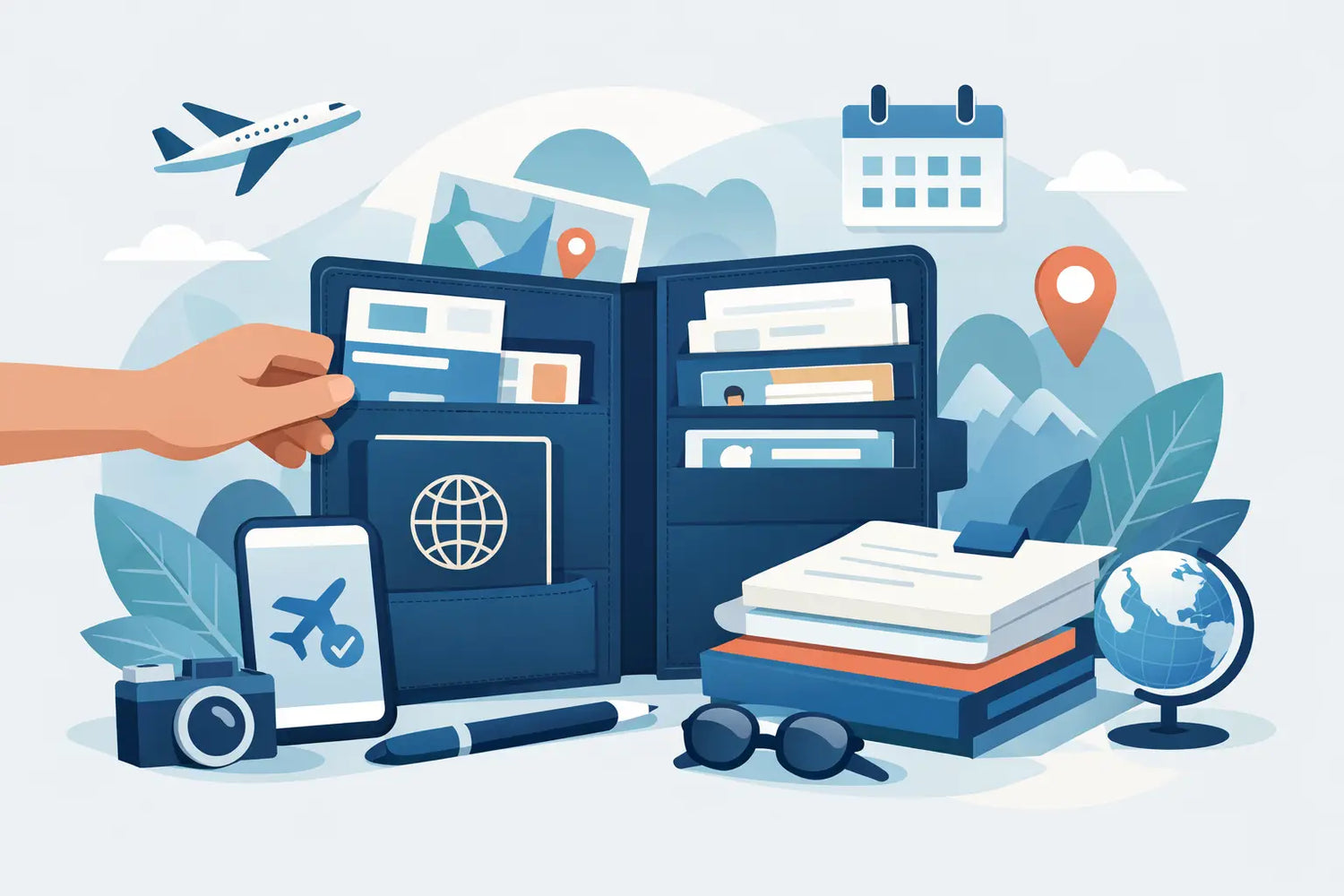
You feel disorganized at the worst possible moment - passport in one pocket, boarding pass folded into a jacket, backup card buried in a carry-on. If you want to know how to organize travel documents, the goal is simple: keep every essential in one place, easy to reach, and slim enough to carry without thinking about it.
That sounds obvious, but most travel friction comes from small failures in access. Not losing your passport matters, of course. But so does being able to pull out the right card at check-in, find your arrival form before landing, or swap a SIM without emptying your bag onto an airport seat. Good organization is less about storing more and more about storing the right things well.
How to organize travel documents without overpacking
The best system starts by cutting what you carry. Many travelers make the same mistake: they build a travel wallet like a filing cabinet. Old receipts, every loyalty card, multiple currencies from past trips, printed confirmations they will never read again. The result is bulk, and bulk slows you down.
A cleaner approach is to separate travel documents into three categories: must-have, useful backup, and leave behind. Your must-have set usually includes your passport, primary payment card, backup card, a small amount of cash, and any boarding pass or itinerary you need quick access to. Useful backup might include a second ID, a spare SIM, or a printed reservation for destinations where digital access can be unreliable. Everything else can stay at home or live in your phone.
This is where slim design matters. A travel wallet should force a little discipline. If it becomes a pouch for everything, it stops helping. If it holds the essentials in a compact footprint, you move through airports, taxis, hotel check-ins, and daily errands with far less friction.
Build one carry system for every stage of the trip
The easiest way to stay organized is to stop changing your system every time you move. The documents you use at the airport should live in the same place you use on arrival, and ideally in the same wallet you can carry during the rest of your trip.
That means thinking beyond takeoff. Your passport might matter most at immigration, but your cards, cash, and SIM tools matter throughout the trip. If you split those items across a passport holder, a regular wallet, and a backpack pocket, you create unnecessary steps. A better setup combines travel essentials and everyday carry into one refined format.
A compact wallet with dedicated space for passports, payment cards, cash, boarding passes, and small extras solves a problem bulky organizers create. It gives you capacity where you need it, but keeps the shape pocket-friendly. That balance matters. A wallet that holds everything but only fits in a tote is less practical than one you can keep close at all times.
What should stay within immediate reach
For most trips, your immediate-reach items are predictable. Passport, boarding pass, primary card, backup card, and a little cash should be accessible in seconds. If you travel internationally, a SIM card and ejector pin can save time the moment you land. A mini pen is also one of those small details that feels unnecessary until you need it.
The point is not to carry more accessories. It is to remove scattered storage. One slim wallet with intentional compartments usually beats a larger organizer with vague open space.
Create a document order that matches your travel flow
Smart organization is not only about what you carry. It is also about where each item sits.
Place the document you use most often in the easiest-access slot. For departure, that is usually your passport and boarding pass. Your primary card should sit somewhere equally quick to reach, since you may need it for food, lounge access, transportation, or hotel deposits. Backup items can sit deeper in the wallet because they matter less often.
This order should shift slightly based on the trip. For domestic travel, your ID and payment cards may matter more than your passport. For international travel, passport access becomes the priority. On a business trip, keeping a receipt section or an extra card slot might be useful. On a short weekend getaway, you can trim down further.
That flexibility is the real test of a good setup. It should be structured enough to keep things organized, but not so rigid that it only works for one kind of traveler.
Use digital backup, but do not rely on it entirely
A polished travel setup is physical and digital. Keep digital copies of your passport identification page, travel insurance, itinerary, and key reservations stored securely on your phone. That gives you a fallback if something is lost or if a desk agent asks for a detail you do not have memorized.
Still, digital convenience has limits. Phones die. Airport Wi-Fi fails. Apps log out. Some immigration desks and smaller hotels still move faster with paper in hand. That is why the best answer to how to organize travel documents is not fully digital or fully paper. It is selective redundancy.
Carry the physical essentials. Keep digital copies as backup. Print only what could save time if your phone is unavailable.
What is worth printing
For many travelers, a printed boarding pass is optional. A printed hotel confirmation often is too. But there are exceptions. If you are entering a country that asks for proof of onward travel, if you are arriving late and want a fast check-in, or if you know mobile service may be unreliable, one or two printed confirmations can be worth carrying.
Folded papers stuffed into random pockets are where organization falls apart. If you print anything, give it a dedicated place. A boarding pass sleeve or cash slot works well if the wallet is designed for it.
Avoid the common mistakes that create bulk
Disorganization is often a design problem disguised as a packing problem. If your wallet is thick, hard to scan, or overloaded, the issue may be the system itself.
One common mistake is using a standard everyday wallet plus a separate passport holder. That sounds organized, but it splits your essentials in two. Another is carrying too much cash in multiple currencies at once. A third is forgetting small but useful items like a SIM ejector tool, then improvising with a paper clip at the gate.
There is also a trade-off to consider. Large zip travel organizers can feel secure because they hold everything, but they are often too bulky for a pocket and too awkward for quick access. Ultra-minimal card sleeves look clean, but they may fall short for international trips where passport carry is essential. The sweet spot is a wallet slim enough for daily carry and structured enough for real travel needs.
For travelers who want one elegant solution, that is exactly the appeal of a product designed to hold more than its footprint suggests. WhimHold leans into that idea well - big on space, slim in your pocket.
Make document checks part of your routine
Even the best wallet will not save a rushed traveler from last-minute chaos. A simple routine does.
Before leaving home, check that your passport is valid, your primary and backup cards are packed, your cash is right for the first leg of the trip, and any destination-specific documents are loaded where they belong. Before leaving the hotel, do a quick touch check: passport, wallet, phone. Before boarding, reset your wallet so the next document you need is already on top.
This takes less than a minute, but it prevents the awkward airport shuffle that makes travel feel more stressful than it needs to be.
A simple rule for return trips
Trips get messier on the way home. Receipts build up, boarding passes get shoved into card slots, foreign cash collects in corners. Use one rule: clear the wallet before your return leg. Remove what is no longer useful, keep only what supports the journey back, and reset your layout.
That small edit keeps your carry slim and your access clean right when travel fatigue starts to show.
The best travel organization feels invisible
When your documents are organized properly, you stop noticing the system. You move through check-in without fumbling. You land and switch SIMs without searching. You pay, board, and check in with the same slim wallet you use at home.
That is the standard worth aiming for. Not more storage. Not more compartments for the sake of it. Just a compact setup that keeps the right essentials close, protected, and ready when you need them.
If your current travel routine feels bulky, scattered, or one step behind, simplify it until it feels effortless. The right setup should earn its place in your pocket long after the flight ends.

Leave a comment
This site is protected by hCaptcha and the hCaptcha Privacy Policy and Terms of Service apply.