
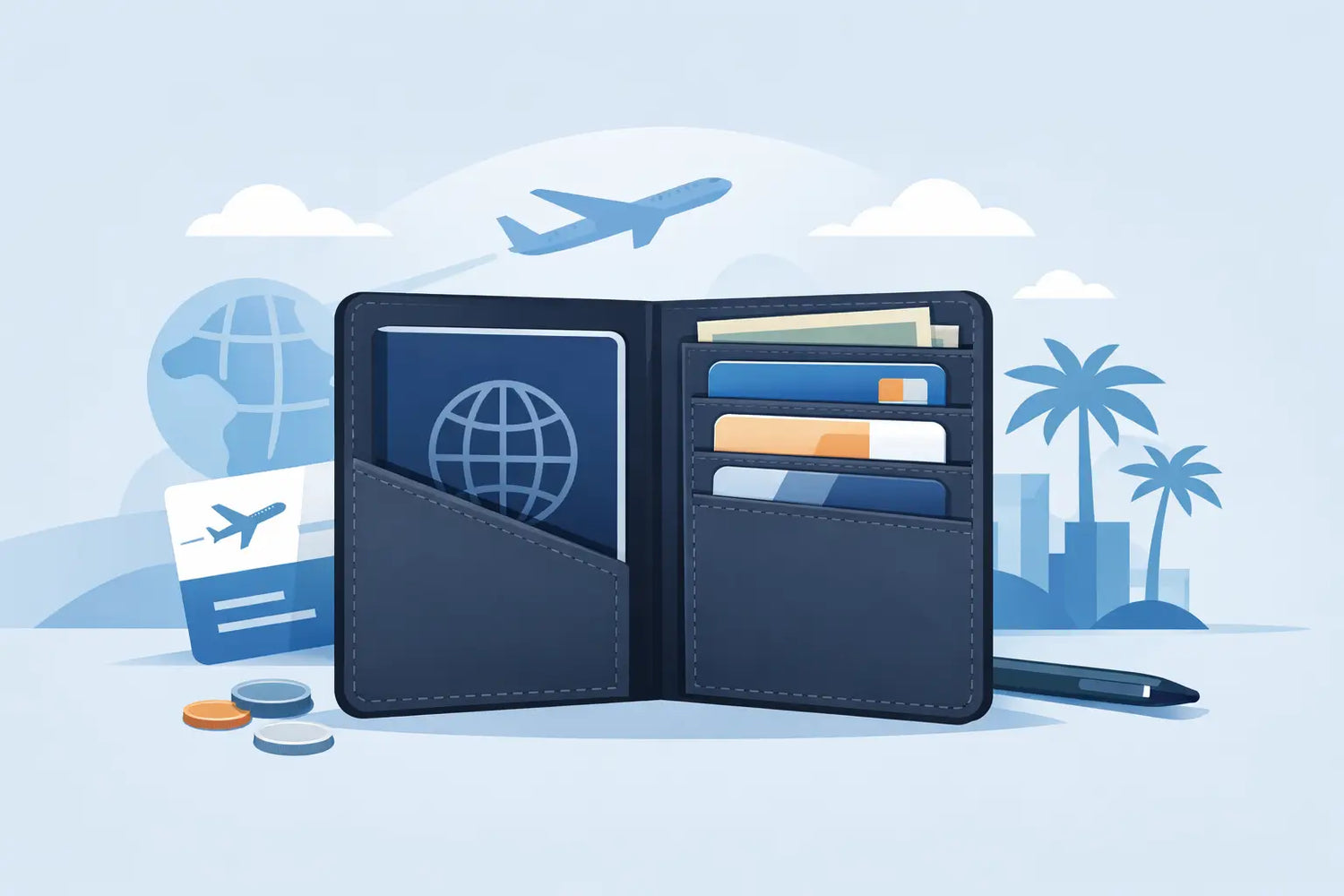
The problem with most travel wallets is easy to spot the moment you put one in your pocket. They promise organization, then turn into a brick. A passport holder with card slots should do the opposite - keep your essentials together while staying slim enough to carry comfortably through security, boarding, and the rest of your trip.
That balance is what separates a smart travel essential from a bulky accessory you stop using after one trip. If you travel often, or simply like your everyday carry to stay clean and efficient, the right passport wallet needs to do more than hold a document. It should reduce friction at every touchpoint, from check-in to arrival.
What a passport holder with card slots should actually do
At a glance, the job sounds simple. Hold your passport. Add a few cards. Maybe fit some cash. But good design shows up in the details.
A well-made passport holder with card slots should let you reach what you need without shuffling through layers of leather, receipts, and folded papers. Your passport should slide in securely but still come out easily at the gate. Your payment cards should stay snug, but not so tight that every purchase feels like a struggle. And if you carry a boarding pass, SIM card, or backup cash, those items should have a defined place instead of being stuffed into one oversized pocket.
This is where many passport wallets miss the mark. They add storage by adding bulk. More panels, more compartments, more thickness. On paper, that sounds useful. In practice, it often means a wallet that feels oversized in your hand and awkward in your jacket or pants pocket.
For most travelers, compact efficiency matters more than raw capacity. You rarely need to carry everything. You need to carry the right things, in the right layout, with quick access.
Slim beats bulky - if the layout is right
A slim passport wallet is only useful if it still carries enough. That is the real design challenge.
Too minimal, and it becomes little more than a passport sleeve with a card slot or two. Too feature-heavy, and it stops feeling premium because it becomes clumsy. The best designs sit in the middle. They use space with intention, so the wallet stays thin while handling the essentials that create the most travel friction.
That usually means room for a passport, a handful of cards, folded cash, and travel-specific items that tend to get lost when you need them most. Think SIM cards, a SIM ejector pin, and a pen small enough for customs forms or quick notes. These details matter most to frequent travelers because they solve real annoyances, not imagined ones.
A slim profile also changes how often you actually use the wallet. If it fits naturally into your everyday carry, you are more likely to keep it with you before, during, and after your trip. That matters because the best passport wallet is not just for takeoff. It should be useful enough to carry even when you are not in an airport.
Materials matter more than most people think
When people shop for a passport holder with card slots, they often focus first on the number of compartments. Fair enough. But the material has a huge effect on how the wallet performs over time.
Cheap synthetic materials can look neat out of the box and feel tired fast. Edges wear down. The structure softens too much. Card slots stretch out. The wallet that once looked sleek starts looking overworked.
Premium leather, especially soft full-grain or high-quality Nappa, tends to age better while keeping a more refined appearance. It also affects the way the wallet carries. Better leather can be thinner without feeling flimsy, which helps preserve that clean, pocket-friendly shape.
There is a trade-off, of course. Leather usually costs more, and some travelers prefer technical materials for weather resistance or a more casual look. But if your goal is an elegant wallet that works for business travel, city trips, and everyday use, premium leather gives you a stronger mix of durability and polish.
It also makes a difference in hand feel. That might sound secondary, but it is not. A wallet is one of the few travel accessories you handle constantly. If it feels stiff, plasticky, or overbuilt, you notice it every time.
The best layout is built around real travel habits
A good passport wallet should match how people actually move through a trip.
You pull out your passport at check-in, security, and boarding. You reach for a payment card at the airport, in a taxi, at a café, and at your hotel. You may need local currency. You may swap SIM cards after landing. Occasionally, you need a pen at exactly the moment you do not have one.
That is why layout matters more than feature count. A wallet designed around real use feels intuitive. You know where everything is. You can access it quickly with one hand. Nothing gets buried under something else.
Card slots should be easy to scan visually, especially if you carry a mix of payment cards, ID, and hotel key cards. A passport sleeve should hold the document securely without forcing you to bend or tug it out. A cash pocket should fit folded bills cleanly instead of crumpling them into a corner. And if there is storage for small travel tools, it should feel integrated rather than tacked on.
This is where ultra-slim design earns its value. It forces smarter decisions. Every slot and compartment has to justify itself. The result is usually a cleaner experience, not a more limited one.
When more storage is not better
There is a reason bulky travel wallets often look impressive online and feel disappointing in person. They are designed to hold everything you could carry, not everything you should.
That sounds like a small distinction, but it changes the product completely. A large zip-around wallet with room for multiple passports, stacks of cash, coins, receipts, and ten cards may suit a family organizer or someone carrying travel documents for several people. But for solo travelers, couples, and frequent business flyers, that much capacity often creates drag.
It is heavier. Harder to slip into a pocket or small bag. Slower to open. Easier to overpack. And once it becomes a storage pouch instead of a wallet, the clean simplicity disappears.
If your goal is mobility, a passport holder with card slots should encourage restraint. Enough room for what matters. No wasted bulk. No oversized format pretending to be practical just because it stores more.
Who should choose a passport holder with card slots
This kind of wallet makes the most sense for travelers who want one compact place for their core essentials. If you are tired of splitting items between your pocket, backpack, jacket, and carry-on, it solves that neatly.
It is especially useful for frequent flyers, business travelers, and hybrid workers who move between daily life and travel mode without wanting a separate setup for each. A well-designed travel wallet can hold your passport and trip essentials while still working as a refined everyday carry.
It is also a smart choice for anyone who values a minimalist setup but does not want to give up function. That combination is harder to find than it should be. Plenty of wallets are slim. Plenty are spacious. Fewer manage to be both.
WhimHold sits squarely in that space, with a design approach built around maximum utility in a minimal footprint. For travelers who want premium materials, efficient storage, and a profile that still feels elegant in hand, that balance is the whole point.
How to judge one before you buy
Photos can make almost any wallet look sleek, so it helps to think beyond appearance. Check whether the design explains capacity clearly. If a product says it holds cards, cash, and a passport, the real question is how many and how comfortably.
Look for thoughtful extras only if they serve a clear purpose. SIM storage and a mini pen are genuinely useful for many international travelers. Endless compartments are not. Also pay attention to thickness. A passport wallet should not become bulky the moment you actually use the card slots.
Material quality, stitching, edge finish, and slot placement tell you a lot. So does the overall silhouette. If it already looks thick when empty, it will almost certainly feel too bulky when loaded.
And finally, think about where you will carry it. In a back pocket? A blazer pocket? A small crossbody or carry-on organizer? The answer should shape your choice more than the total number of slots.
Travel gear works best when it removes small frustrations before they become part of the trip. The right passport wallet does exactly that - it keeps what matters close, easy to reach, and slim enough that you barely notice it until you need it.

Leave a comment
This site is protected by hCaptcha and the hCaptcha Privacy Policy and Terms of Service apply.